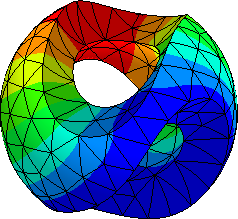

Boundary Element Methods#
Boundary element methods solve boundary value problems by representing the solution with layer potentials on the boundary.
Typical model problems:
Laplace,
Helmholtz,
Maxwell,
elasticity / Lamé.
Main tradeoff:
Pro |
Contra |
|---|---|
unknowns live only on the boundary |
integral kernels are singular |
exterior domains are handled naturally by the fundamental solution |
discrete operators are dense |
solution can be evaluated anywhere from the layer potential |
volume source terms need additional potentials |
Solution Representation#
Model Helmholtz problem:
BEM represents the solution by a layer potential with an unknown boundary density. For the single layer ansatz in the domain,
Taking the boundary trace gives the boundary integral equation for the density
Boundary Discretization#
For the single layer ansatz, the boundary integral equation is
Choose a finite dimensional boundary space
The Galerkin variational formulation is: find \(\rho_h \in X_h\) such that
with system matrix
A matrix vector product contains a potential evaluation: density values on source quadrature points are passed through the kernel \(G_\kappa(x,y)\) and accumulated at target quadrature points.
This is the computational bottleneck: far away boundary elements still interact through the Green’s function, so the discrete operator is dense.
FMM keeps near interactions direct and replaces far interactions by compressed Green’s function expansions.